
MINAZUKI
A Moment in Kyoto
Minazuki
When June arrives, it’s not just me who starts feeling a little excited.
As the middle of June approaches, Minazuki begins appearing in the display windows of traditional Japanese sweet shops, and that always brings me joy.
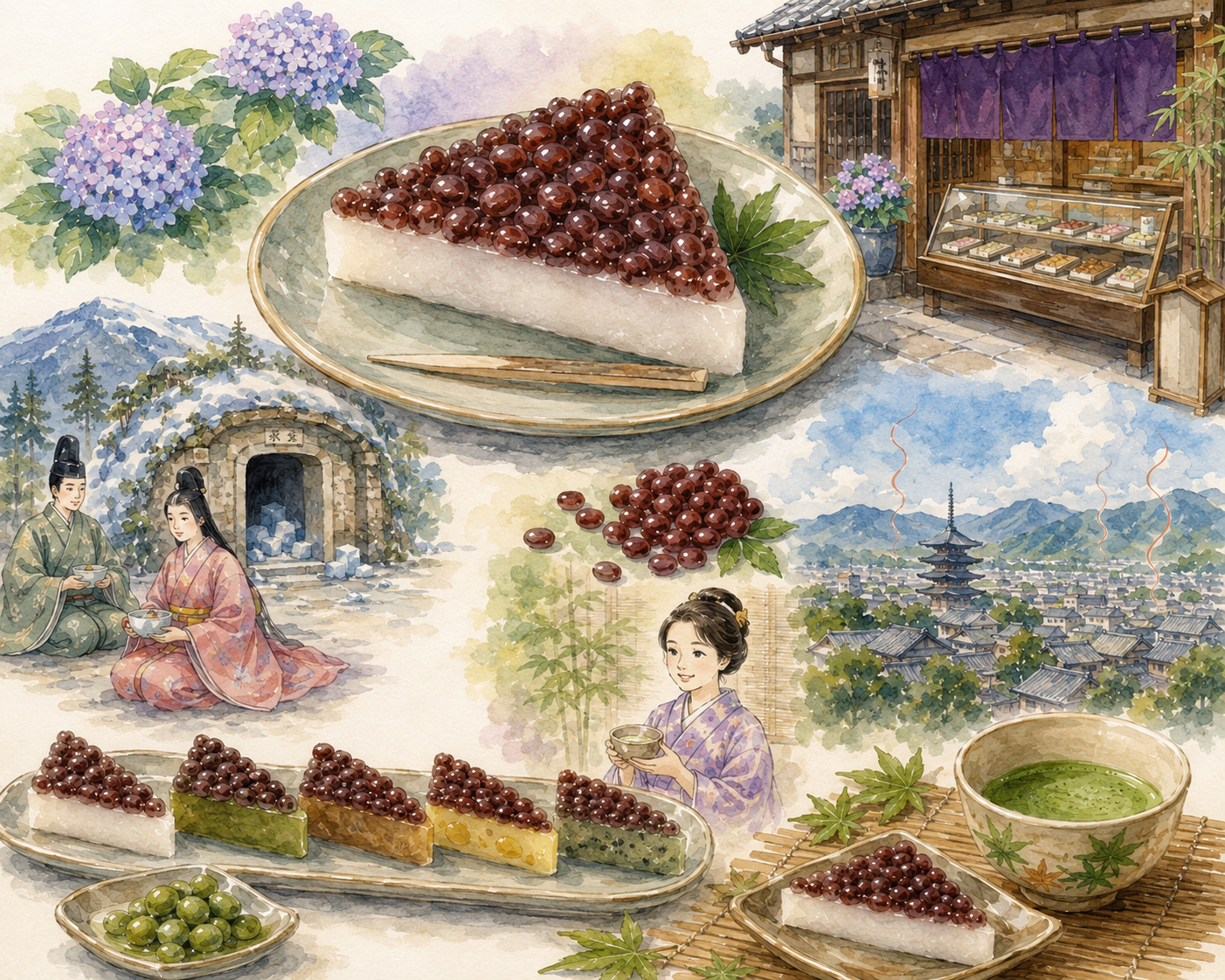
A triangle of white uirō (a soft rice-flour sweet), shaped to resemble a piece of ice, is generously topped with glossy Dainagon red beans.
Its light yet pleasantly chewy texture fills your mouth, and it is simply delicious.
In Kyoto, there has long been a custom of eating ice on the first day of the sixth month in the old lunar calendar, a day known as the “Festival of Ice,” to help prevent summer fatigue.
During the Heian period, members of the imperial court enjoyed ice that had been stored through the winter in ice houses (himuro) in Nishigamo.
Of course, such precious ice was far beyond the reach of ordinary people.
It is said that around the Muromachi period, people began eating sweets shaped like ice instead, and that is how Minazuki came to be.
Red beans are also packed with nutrients, including dietary fiber, polyphenols, and iron.
Summer in Kyoto is not merely hot—it is intensely humid.
Because the city lies in a basin surrounded by mountains on three sides, the wind is often weak, and heat tends to linger, creating a heavy, muggy atmosphere.
Perhaps people ate nutritious red beans to help protect themselves from summer exhaustion.
The people of old were truly wise.
Depending on the sweet shop, the uirō base comes in five varieties: plain white, matcha, brown sugar, chestnut, and mugwort. Some versions even use green peas instead of red beans.
As we prepare to welcome another hot summer, why not enjoy a piece of Minazuki together with a bowl of matcha tea?
— Naomi